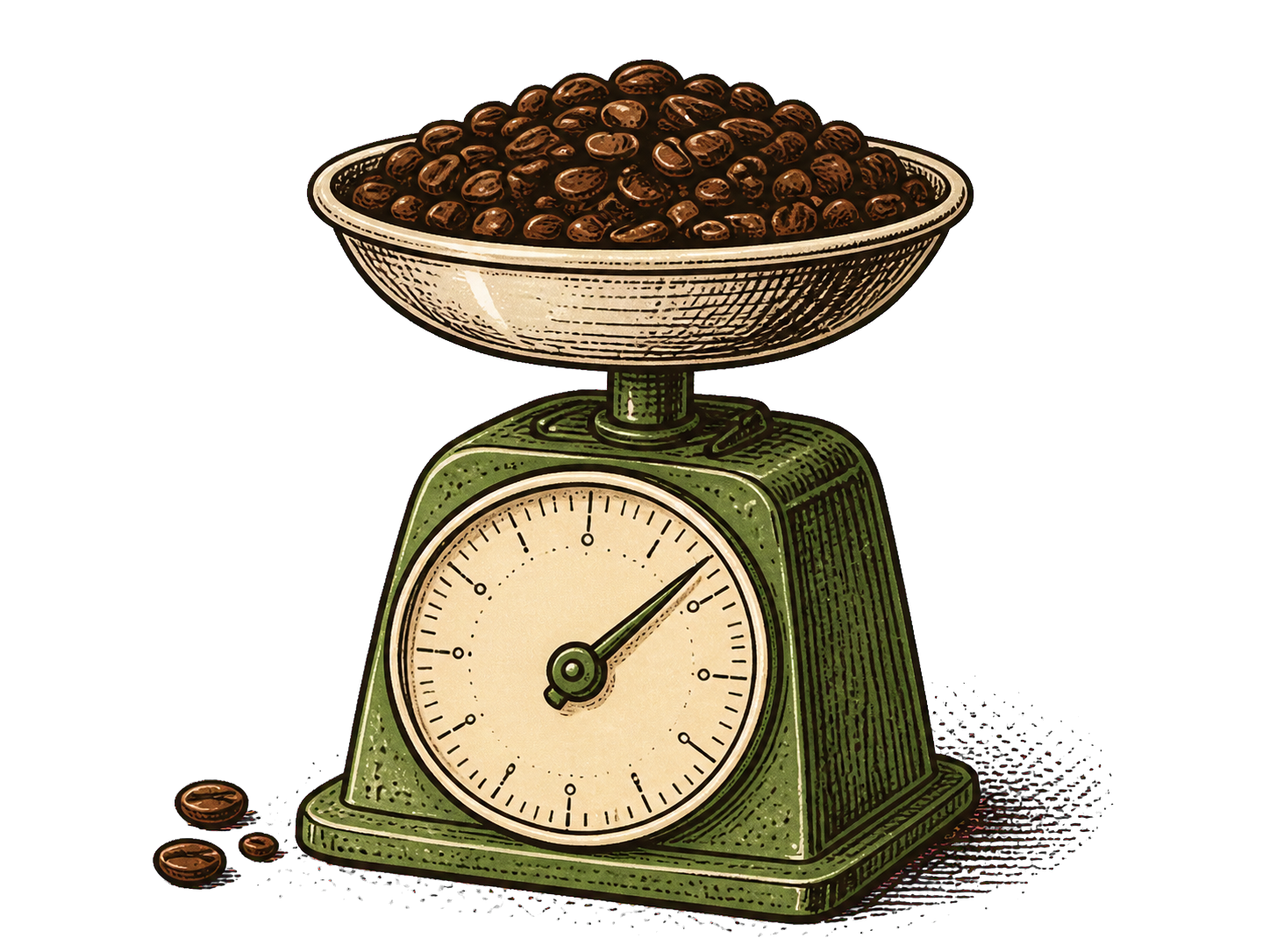
Coffee does not need a laboratory, but it does appreciate a number. A small kitchen scale turns one vague scoop into a repeatable starting point. That is the whole case for weighing your beans: not precision for its own sake, just a way to make tomorrow’s cup taste like today’s.
Most coffee frustrations hide inside tiny changes. A spoon lands a little fuller. The beans are denser than the last bag. The grinder holds back half a gram. None of those differences looks dramatic on the counter, but together they can shift a cup from balanced to weak or unexpectedly sharp.
Weight gives those changes a name. Once you know how much coffee and water went into a brew, you can adjust one thing at a time instead of starting over with another guess.
Scoops measure space, not coffee.
A tablespoon tells you how much room the beans occupy. It does not tell you how much coffee is actually there. Roast level, bean size, origin, and the shape of the scoop all change how much mass fits into the same volume.
Dark-roasted beans tend to be larger and less dense because more moisture has left them during roasting. Light-roasted beans are often smaller and denser. Fill the same scoop with each and the weights can differ enough to change extraction noticeably. Ground coffee adds another variable: fine grounds pack tightly while coarse grounds leave more air between particles.
This is why a familiar scoop sometimes makes an unfamiliar cup. The tool did exactly what it promised. It measured a scoop. The brew needed grams.
A scale does not make coffee fussy. It makes the fussy part repeatable.
Start with one useful ratio.
The easiest home-brewing ratio is one part coffee to sixteen parts water. That means 20 grams of coffee for 320 grams of water, or 30 grams of coffee for 480 grams of water. The numbers scale without changing the flavor target.
One-to-sixteen is not a law. It is a plain starting point. If the cup tastes thin even when the grind and brew time are sensible, use a little more coffee. If it feels heavy or crowded, use a little less. A scale lets you make that adjustment deliberately. Moving from 20 grams to 21 grams is information. Adding “a bit more” is a memory test.
Water is especially easy to weigh because one milliliter is almost exactly one gram. Put the brewer on the scale, press tare, and pour until the display reaches the number you want. There is no separate measuring jug and no need to judge a line through steam.
The ten-second routine.
Weighing adds less time than looking for the scoop that disappeared into the flour drawer. Set the empty brewer or dosing cup on the scale and press tare. Add beans until you reach the target. Grind them, return the brewer to the scale, and press tare again before adding water.
That second tare is the useful trick. It resets the display to zero without forgetting the weight underneath. You can pour water directly into the brewer and watch only the amount that matters.
For a drip machine, weigh the water before filling the reservoir. For a French press, leave the press on the scale while you pour. For a pour-over, the scale can track both total water and pouring pace, but pace is optional. Total water does most of the practical work.
Do not chase the final decimal. A reading of 20.1 grams is not meaningfully better than 20 grams for breakfast. The goal is to remove large accidental swings, not to turn the kitchen into a calibration department.
What consistency teaches you.
Once dose and water stay still, other changes become easier to taste. If coffee runs through a pour-over too quickly and tastes sour, the grind may be too coarse. If it stalls and tastes dry, the grind may be too fine. Without a stable ratio, either problem could also be caused by a different amount of coffee.
This is the quiet value of measurement: it narrows the list of suspects. You can change the grind while holding the ratio steady. You can compare two water temperatures with the same dose. You can decide whether a new coffee prefers a stronger recipe without wondering how full yesterday’s scoop was.
Write down the numbers only when something is excellent or clearly wrong. A note such as “20 g coffee, 320 g water, grinder 14” is enough to find the cup again. There is no prize for documenting every Tuesday.
Any simple scale will do.
A coffee scale is convenient, but it is not mandatory. A basic digital kitchen scale that reads in grams is enough. Look for a tare button, a display you can see beneath the brewer, and a capacity that can handle the brewer plus its water.
Resolution to one gram works for larger batches. A scale that reads to a tenth of a gram is handy for single cups and espresso, where small dose changes matter more. A built-in timer is pleasant for pour-over, though the timer on a phone works exactly as well.
Speed matters more than a long feature list. A sluggish scale keeps counting after you stop pouring and encourages overshooting. If your scale lags, slow the pour near the target and let the number settle. That small habit costs nothing.
Keep the scale dry, wipe away stray grounds, and store it somewhere easier to reach than the scoop. Convenience is what turns a technique into a routine.
If several people make coffee in the same kitchen, leave the ratio beside the grinder. A small note with the dose, water, and grind setting saves everyone from inventing a private version of the recipe. The scale becomes shared language instead of another appliance with a mysterious button.
Use the number, then taste.
The scale cannot decide what tastes good. It can only tell you what you did. Your palate still makes the final call.
Begin with a sensible ratio, brew the coffee, and taste it after it cools for a few minutes. If it is balanced, keep the recipe. If it needs work, change one variable and try again. The number gives you a reliable path back.
That is why weighing beans is worth the counter space. It replaces a shaky visual estimate with a small fact, then gets out of the way. Better coffee follows because repeating the good cup is finally possible.